

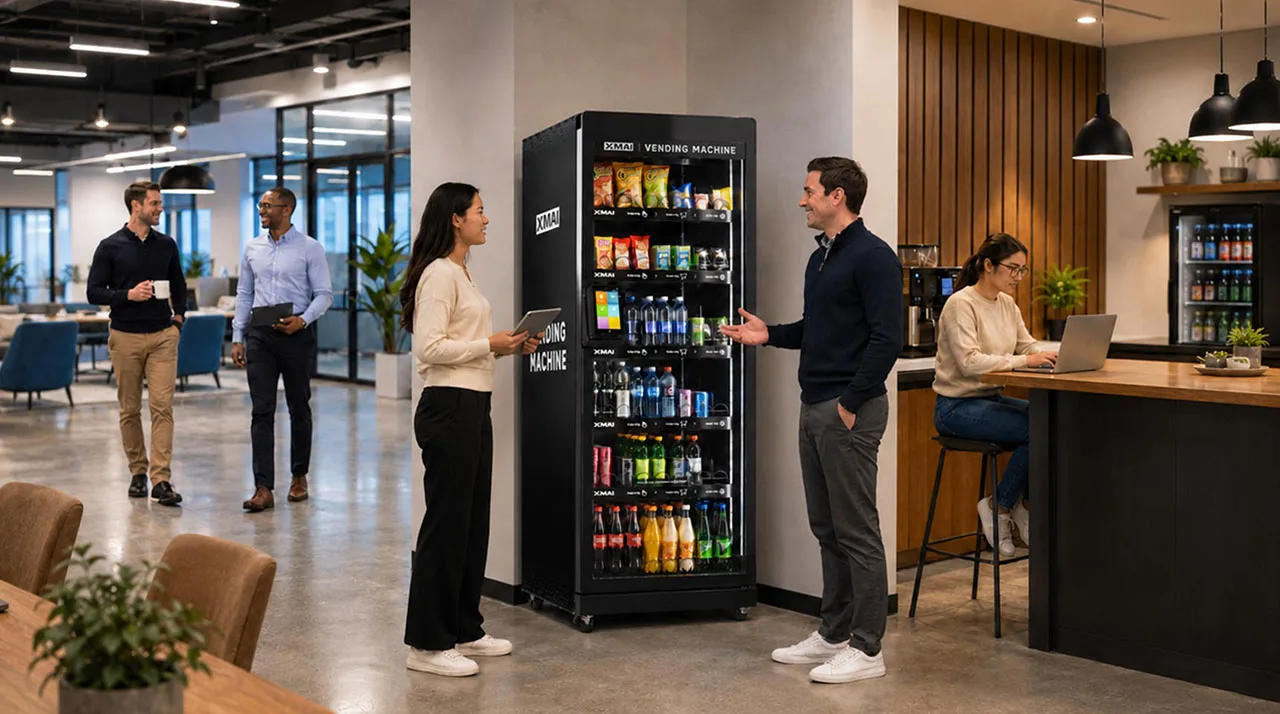
How Much Does an AI Smart Vending Machine Cost?
The vending machine market doesn’t have one price — it has several markets stacked on top of each other, and most sites don’t bother separating them. A basic snack machine, a refrigerated combo unit, and an AI-powered smart cooler all get called “vending machines,” but they sit in completely different price brackets. If you’re trying to budget for one, the category you’re shopping in matters more than any single number on a page.
Here’s how the market actually breaks down, and where a machine like XMAI’s fits into it.
How much does a vending machine cost?
Rough current market ranges:
- Basic coil snack machines: $3,000–$5,000 new, $1,200–$2,500 used
- Refrigerated drink machines: $4,000–$6,000 new
- Combo (snack + drink) machines: $3,000–$6,000 new
- AI vision smart coolers: $10,000–$30,000+ at most manufacturers
That last category is where things get confusing, because “AI-powered” gets used loosely — sometimes it means full camera-based recognition and cashless checkout, sometimes it just means a touchscreen bolted onto an otherwise traditional machine. Worth asking what’s actually included before comparing two “AI vending machine” quotes side by side.
XMAI’s five models run $2,999–$7,499, positioned closer to a traditional combo machine’s price than to most other smart coolers, while including the same AI recognition and cashless payment features you’d find in machines priced three to four times higher.
Traditional vending machine vs. AI smart vending machine cost
The upfront number is only one side of the comparison. The other side is what happens after the machine is installed.
| Traditional Machine | AI Smart Vending Machine | |
| Upfront cost | $3,000–$7,000 | $2,999–$30,000+ (varies widely by brand) |
| Payment | Usually cash + basic card reader | Full cashless: card, tap, mobile wallet |
| Inventory visibility | Manual counts, on-site only | Remote monitoring, low-stock alerts |
| Product tracking | Coil sensors, prone to jams/miscounts | Camera-based recognition tracks items taken and returned |
| Restocking | Based on a fixed schedule or guesswork | Based on actual sales data |
| Recurring fees | Usually none | Software/connectivity fees apply |
According to NAMA (National Automatic Merchandising Association) figures, the average traditional vending machine generates around $4,416 in annual sales. Machines in high-traffic locations, particularly ones with better product visibility and cashless options, tend to run well above that baseline — operators switching from spring-coil machines to AI-based cashless units commonly report profit gains in the 20–30% range, largely from reduced shrinkage and fewer wasted restock trips, not from higher prices.
What affects smart vending machine pricing?
A few variables move the number within any given brand’s range:
- More shelves and can capacity means a bigger cabinet and a higher price. This is usually the single biggest driver.
- Compact units for break rooms and small lobbies cost less than machines sized for factory floors or transit hubs.
- Payment and recognition technology.Full AI vision recognition with cashless-only checkout costs more to build than a machine with a bolted-on card reader and basic weight sensors.
- Branding/customization.Custom wraps or OEM builds add a modest cost on top of the base unit.
- Warranty coverage.Standard warranties are usually included; extended coverage is typically a separate line item.
- Order volume.Multi-unit and dealer orders generally unlock lower per-unit pricing across the industry.
With XMAI specifically: the base $2,999–$7,499 range moves almost entirely on capacity (Core through Ultra Max), since AI recognition, cashless payment, and remote monitoring are standard across every model rather than gated behind a higher tier.
XMAI Core starting price
As a reference point for where the entry tier of this market sits: XMAI’s Core 425L starts at $2,999 — six shelves, about 336 cans, sized for lower-traffic locations like break rooms or small apartment lobbies. It’s a useful benchmark because it shows that “AI-powered” and “affordable” aren’t mutually exclusive categories, even though a lot of the market treats them that way.
From there, XMAI’s lineup scales by capacity up to the Ultra Max 1500L at $7,499 (1,110+ cans), with three sizes in between for mid- and high-traffic locations.
Software, payment, and operation costs
Any cost comparison that stops at the hardware price is incomplete. Recurring costs are where budgets actually go wrong. For XMAI’s platform specifically:
| Item | Cost |
| SaaS platform | $15/month/unit |
| IoT SIM (4G) | $15/month/unit |
| POS terminal | $10/month/unit |
| AI recognition fee | $0.05/transaction |
| Payment processing | 5.95%/transaction |
| Extended warranty (optional) | $140–$480 |
That’s roughly $40/month in flat fees per unit, with the transaction-based fees scaling with sales rather than adding fixed overhead. No revenue share on top. Industry-wide, ongoing vending costs (product, payment processing, maintenance) typically run 50–70% of revenue depending on category — so the software and connectivity layer on a smart machine is a small slice of the real operating cost, not the dominant one.
Financing options
Financing is common across the industry for multi-unit purchases, and terms vary significantly by lender and machine type — anywhere from 12 to 60 months depending on the vendor. XMAI offers financing for qualified buyers, with terms set based on order size and credit profile rather than a flat published rate. There’s no lease-to-own option — financing applies to purchase only.
Request XMAI pricing
Model, capacity, and unit count all move the final number — tell us those and we’ll send back a real quote.
Email: sales@xmaivending.com
Phone: +1 (650) 307-1228