

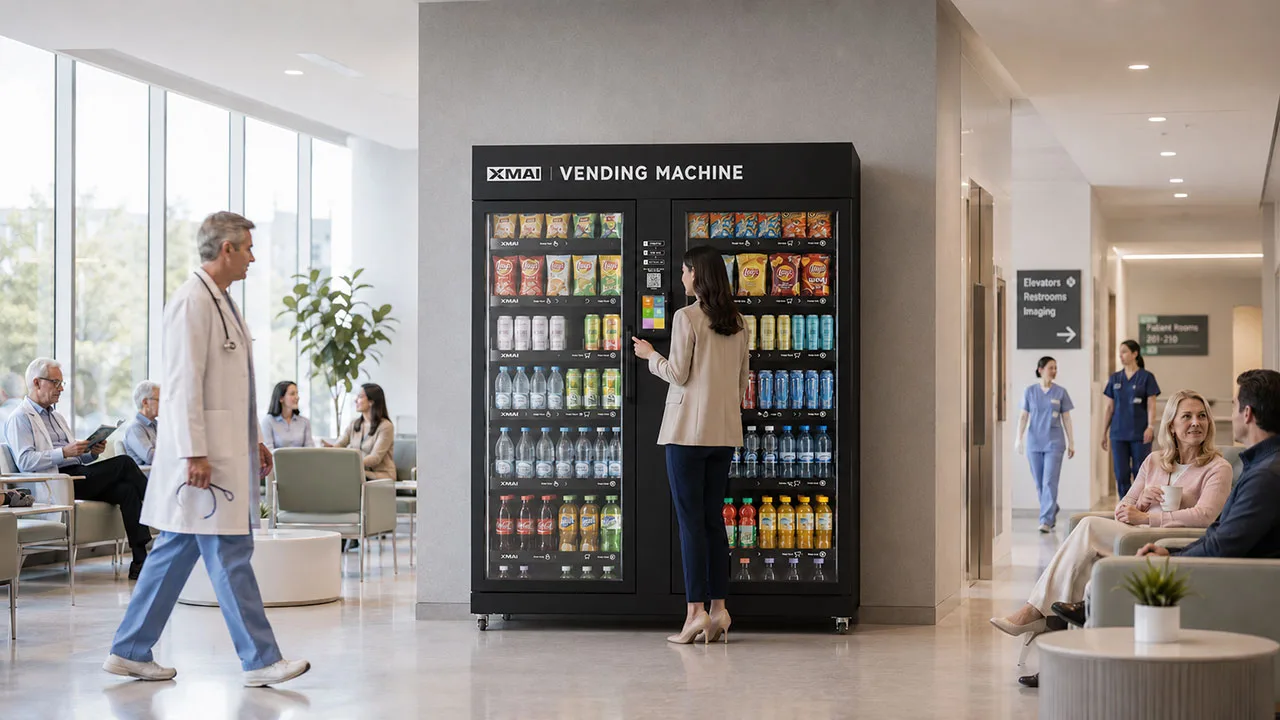
Are vending machines profitable? Yes — but the honest answer is “it depends on location, machine type, and product mix,” the same way it would for any small retail investment. A poorly placed machine in a low-traffic hallway will lose money regardless of how nice it looks. A well-placed machine in a high-traffic office, apartment complex, or factory can generate meaningful, largely passive monthly income.
This guide breaks down real revenue and profit numbers, what actually drives profitability, and the honest pros and cons of getting into this business.
Are Vending Machines a Good Investment? Quick Answer
Vending machines can be a good investment when three conditions are met:
- The location has consistent daily foot traffic(40+ regular people is a commonly cited minimum)
- The machine and product mix match what people at that location actually want to buy
- The operator keeps ongoing costs — restocking trips, processing fees, maintenance — under control
When those three line up, a single machine can pay back its upfront cost within months and continue generating profit for years. When they don’t, even the most advanced machine will underperform.
How Much Do Vending Machines Make a Month? (Real Numbers)
This is the single most-searched question in this space, so here’s a straight answer with sourced benchmarks.
According to NAMA (the National Automatic Merchandising Association), the average vending machine generates roughly $4,416 in annual sales — a useful industry-wide baseline, though it blends every machine type and location quality together, from an underperforming machine in a quiet break room to a high-traffic unit in a busy factory.
| Metric | Typical Range |
| Average vending machine revenue (industry baseline) | ~$4,416/year (~$368/month) |
| Vending machine revenue, high-traffic location | $500–$1,500+/month |
| Soda/drink machine profit margin | 20–40% of revenue, depending on product cost and location commission |
| AI smart cooler revenue (high-traffic location) | Often 2–3x a comparable traditional machine, per operator-reported data |
| Vending machine profit per month, single well-placed unit | Commonly $100–$400+ net, after restocking, processing, and platform fees |
The gap between the industry-wide average and what a well-placed machine can make is the real story here: how much money a vending machine makes is driven far more by location quality and machine type than by the vending industry as a whole.
How Vending Machine Profit Actually Works
Vending machine income breaks down into a simple formula:
Revenue − Cost of Goods − Location Commission − Processing/Platform Fees − Restocking Costs = Net Profit
A rough breakdown for a typical location:
- Cost of goods sold:usually 40–60% of revenue (what you pay for the snacks, drinks, or food you’re stocking)
- Location commission (if any):many property owners take 5–15% of revenue in exchange for hosting your machine, though many locations charge no commission at all, especially for first-time placements
- Payment processing:roughly 5–6% per transaction for cashless payments
- Platform/software and connectivity fees:commonly $30–$40/month per machine for smart, connected units
- Restocking and maintenance:your time, or a route driver’s time, plus occasional parts and repairs
After those line items, a machine doing $600/month in sales at a mid-range location might net somewhere between $150–$300/month in real profit — which is why location selection matters more than almost any other decision you make.
What Affects Vending Machine Profitability?
- Location, location, location.A machine in a spot with 40+ daily regular visitors will consistently outperform one in a quiet, low-traffic hallway, regardless of how advanced the machine is.
- Product mix.Matching what you stock to who’s actually walking by — protein drinks in a gym, grab-and-go meals in an apartment lobby, coffee and snacks in an office — has a bigger impact on sell-through than almost any other variable.
- Machine type.Traditional coin machines cap out on both product variety and customer experience. AI smart coolers let customers browse and grab multiple items in one transaction (instead of one item per coin insertion), which measurably increases average order value.
- Payment options.Machines that only accept cash lose sales from customers who simply don’t carry it. Cashless-only, tap-to-pay machines remove that friction entirely.
- Uptime and restocking discipline.A machine that’s frequently out of stock or broken doesn’t just lose that day’s sales — it trains customers to stop checking it at all.
Are Vending Machines Profitable? Pros and Cons
Pros:
- Low overhead compared to a traditional retail storefront
- Scalable — the same playbook (location, machine, product mix) repeats across new locations
- Largely passive income once a route is established
- Cashless, AI-powered machines significantly reduce theft and inventory shrinkage compared to older mechanical units
- No employees required to operate a single machine or small route
Cons:
- Revenue is highly location-dependent — a bad location will underperform no matter what
- Requires consistent restocking, which takes real time and travel, especially with multiple machines
- Upfront equipment cost, even with financing, is a real investment that takes time to pay back
- Perishable or fresh food product lines require more frequent restocking and closer expiration monitoring
- Not fully passive — someone still has to manage inventory data, respond to maintenance alerts, and renegotiate underperforming locations
Why AI Smart Coolers Tend to Outperform Traditional Machines on Profit
A large share of the profitability gap between operators isn’t the location — it’s the machine. Traditional spring-coil machines are built to dispense one item at a time and offer no visibility into what’s selling until you physically check. AI-powered smart coolers change the underlying economics in a few specific ways:
- Higher basket size:customers can grab multiple items per visit instead of one item per transaction, which operators consistently report as a meaningful driver of the 20–30% higher profit margins seen versus traditional spring machines
- Reduced shrinkage:AI vision tracking automatically verifies what a customer takes and charges accordingly, cutting into the product loss that eats into margin on older machines
- Remote sales visibility:knowing which SKUs are moving and which aren’t lets operators stop restocking dead inventory and reallocate shelf space to what’s actually selling — a data advantage that’s simply not available on coin-operated machines
- Fewer wasted trips:low-stock alerts mean operators visit machines when they actually need restocking, not on a fixed schedule that wastes time on slow-moving locations
For operators asking whether investing in vending machines is worth it, the honest framing is: the industry-wide average is modest, but the gap between an average machine and a well-run, well-placed AI smart cooler is significant — and that gap is squarely within an operator’s control.
How to Start Making Money With Vending Machines (For Beginners)
If you’re evaluating this as a beginner, the fastest path to profitability generally looks like:
- Secure one strong location before buying equipment — don’t buy first and search for a location after
- Choose a machine that matches the location’s traffic level and product needs
- Track sales by product from day one so you can adjust your mix quickly
- Reinvest early profits into a second machine at a proven-similar location rather than spreading budget across untested spots
- Treat restocking discipline as part of the job, not an afterthought — out-of-stock shelves are lost revenue
For the full step-by-step process of getting your first machine placed and running, see our companion guide, “How to Start a Vending Machine Business.”
FAQ: Vending Machine Profitability
Are vending machines profitable in 2026?
Yes, for well-placed machines with the right product mix. Industry-wide averages are modest (~$4,416/year per NAMA), but high-traffic, well-run locations regularly exceed that baseline.
How much money can a vending machine make per month?
Anywhere from under $100/month for a poorly placed machine to $500–$1,500+/month for a well-placed unit in a high-traffic location.
Is investing in vending machines a good business for beginners?
Yes, it’s one of the more accessible small business models — low overhead, no required employees, and a repeatable playbook — as long as location selection and restocking discipline are taken seriously.
Do AI smart coolers make more money than traditional vending machines?
Operator-reported data generally shows 20–30% higher profit margins for AI-powered smart coolers versus traditional spring/coil machines, largely driven by higher basket sizes and reduced shrinkage.
What’s the biggest factor in vending machine profitability?
Location quality, by a wide margin — followed closely by product mix and how consistently the machine stays stocked and functional.