

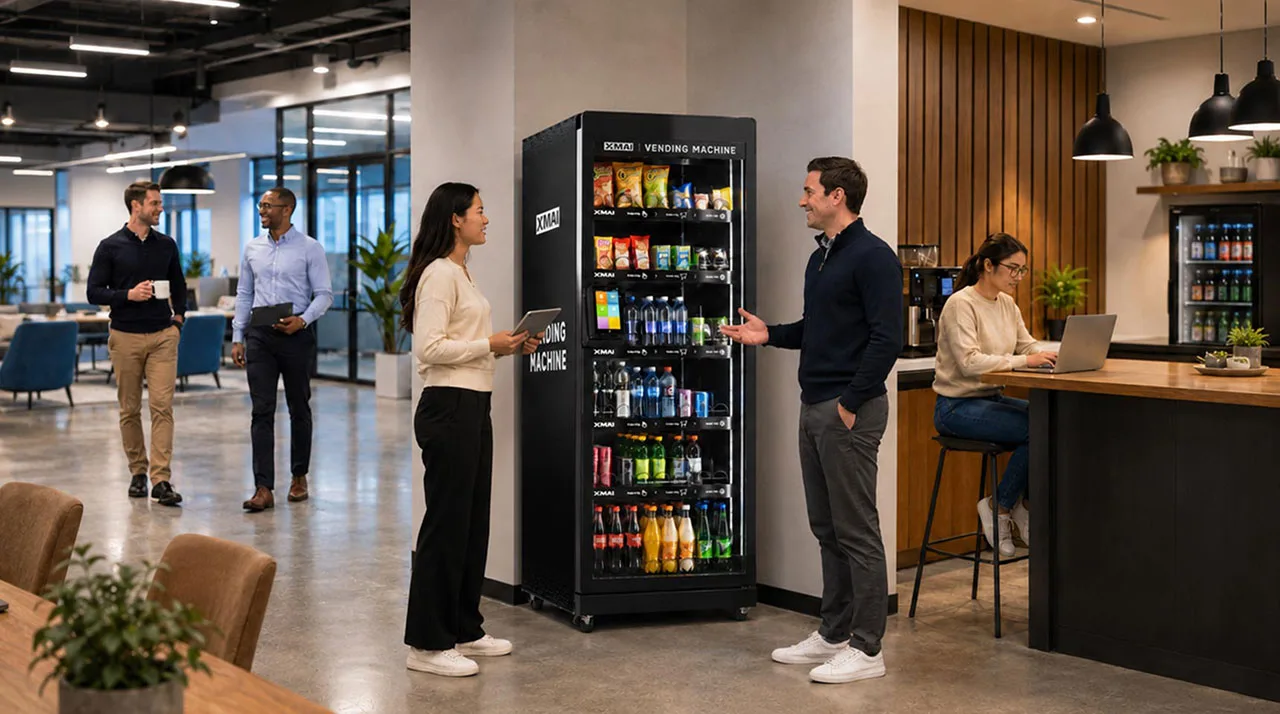
XMAI is a global manufacturer of AI-powered smart coolers and a technology partner for unattended retail. We’re not assembling other companies’ hardware and layering a dashboard on top; the recognition system, the cabinet design, and the software platform are built in-house, which is part of why the five machines in this lineup all run the same core technology instead of a patchwork of specs depending on model.
Ten years into building AI vending recognition specifically, that work is running in production today: over 5,000 operators, more than 300,000 units shipped, deployed across offices, apartments, factories, and campuses.
Smart vending machines built for modern retail
Five models, one platform. Core, Pro, Max, Ultra, and Ultra Max scale from about 336 cans up to 1,110+ cans, sized for everything from a break room to a factory floor. Every unit ships standard with Dynamic Vision AI recognition, EMV cashless payment, and 4G/WiFi/Ethernet connectivity — none of that is gated behind a higher-priced tier. What changes as you move up the lineup is capacity and footprint, not whether the machine is “smart.”
AI vision, cashless checkout, and cloud management
The three pieces work as one system, not three separate add-ons. Cameras track what’s taken and returned, cashless payment settles the transaction the moment the door closes, and the management platform gives operators real-time visibility into every unit — sales, inventory, device health, temperature — from a phone or laptop, without a site visit. Recognition accuracy runs at 99.7%, measured from actual transactions across the installed base rather than lab conditions.
Loss prevention runs underneath all of it: reinforced cabinet construction, real-time alerts on abnormal door activity, pre-authorization before the door unlocks, automatic retry on failed charges, and account restrictions for repeat abuse. It’s a system built around protecting the revenue coming through the machine, not just the machine itself.
Smart vending vs traditional vending
A traditional coil or shelf machine still has a place — lower cost upfront, no recurring software fees, fewer things that can go wrong electronically. What it can’t do is tell an operator a shelf is running low before someone shows up to find it empty, or distinguish a completed transaction from a jammed one without a person standing there. Operators moving from spring-coil machines to AI-based cashless units commonly report profit gains in the 20–30% range — mostly from reduced shrinkage and fewer restock trips wasted on locations that didn’t actually need one, not from charging customers more.
Use cases: offices, gyms, apartments, campuses
The lineup covers a wide range of location types by sizing rather than by feature set:
- Offices— Core or Pro for break rooms and smaller floors, Max for larger buildings with heavier daily traffic
- Apartments— Core or Pro for lobbies and common areas, sized to resident count rather than square footage
- Gyms— Pro or Max, depending on member volume and whether it’s a single location or a multi-site chain
- Campuses— Ultra or Ultra Max for dorms, libraries, and student centers where daily traffic runs into the hundreds
If you’re not sure which size fits, tell us the traffic and the space and we’ll size it rather than have you guess off a spec sheet.
XMAI hardware and software platform
On the hardware side: Pure Air Cooling keeps temperature stable across 28°F–64°F with quieter, lower-energy operation than older refrigeration designs, and the refrigeration module is field-swappable, so a repair doesn’t mean the whole unit goes back to a shop. Every machine goes through inbound component inspection, in-process quality checks, and a final pre-shipment test — continuous operation, simulated transactions, transport durability — before it leaves the factory.
On the software side: the management platform handles remote monitoring, inventory alerts, pricing updates, and sales reporting across every location an operator runs, with OTA software updates pushed without a technician on site.
Pricing and financing
Pricing runs $2,999–$7,499 across the five models, with no minimum order — plenty of operators start with one unit before scaling. Ongoing platform costs run about $40/month per unit (SaaS, IoT connectivity, POS), plus a small per-transaction AI fee and standard payment processing — full breakdown on our pricing page. Financing is available for qualified buyers, with terms set based on order size and credit profile.
Talk to sales
Whether you’re placing your first unit or rolling out across multiple sites, tell us your location type and traffic and we’ll put together model recommendations and real pricing.
Email: sales@xmaivending.com
Phone: +1 (650) 307-1228