

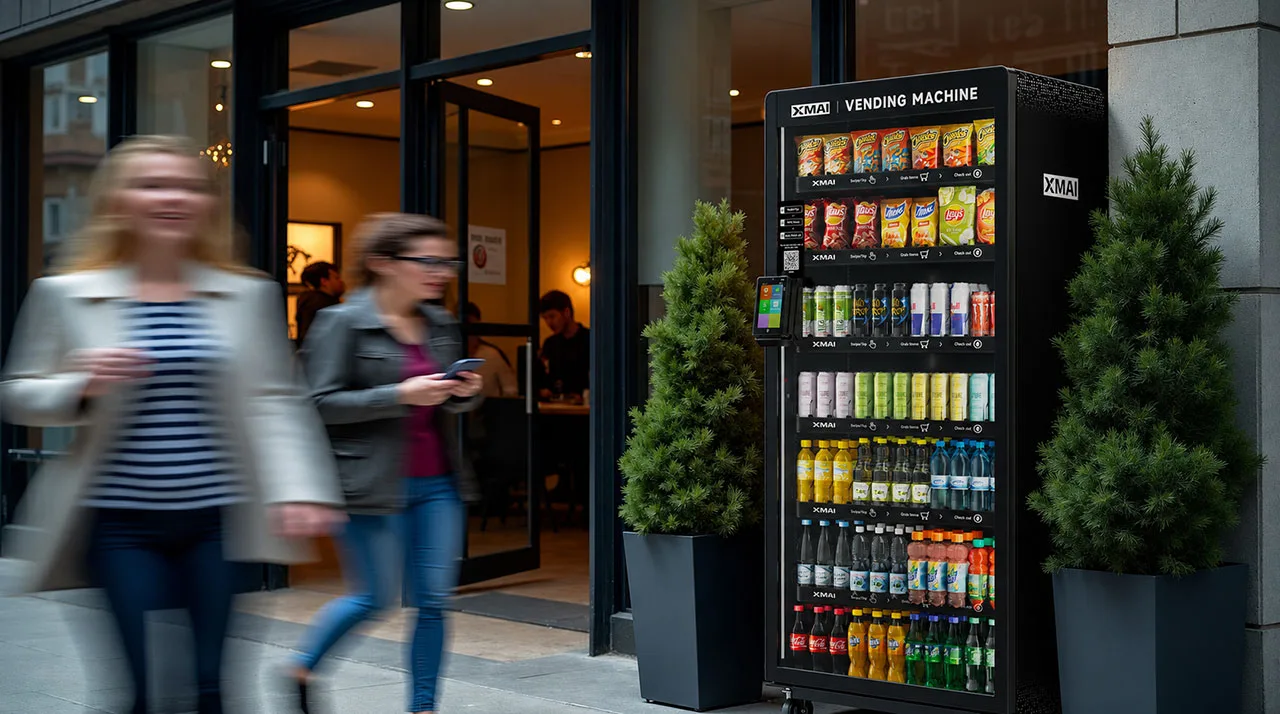
AI Smart Vending Machines for Sale
XMAI is a global manufacturer of AI-powered smart coolers and a technology partner for next-generation unattended retail — not a reseller bundling someone else’s hardware with a software layer on top. In the U.S., we operate as NexMart Smart Inc. Ten years into building AI vending recognition technology, over 5,000 operators are running XMAI machines today, with more than 300,000 units shipped and deployed across offices, apartments, factories, and campuses.
That track record is the short version of why “buying a smart vending machine” from XMAI means buying from the company that built the recognition system, not a middleman reselling it.
Buy AI smart vending machines for your business
Five models, all AI-enabled, sized from about 336 cans up to 1,110+ cans. No minimum order — a meaningful number of our operators started with a single unit to prove out a location before ordering more. Every machine, regardless of size, ships with the same standard feature set: Dynamic Vision AI recognition, EMV cashless payment, and 4G/WiFi/Ethernet connectivity, so smaller doesn’t mean stripped-down.
Choosing a smart vending machine isn’t just picking a piece of equipment — it’s picking a partner who’s still going to be answering the phone two years after the sale. That’s the part of this decision that’s easy to skip past when comparing spec sheets.
Why choose smart vending instead of traditional vending
A coil machine still works, and there’s nothing wrong with using one where it fits. What operators run into over time is what a coil machine can’t do: it can’t tell you a shelf is running low before you show up and see it empty, it can’t stop a jam from happening, and it can’t tell the difference between a real transaction and a failed one without you standing there.
XMAI’s AI vision system tracks what’s physically taken out of the cabinet and what’s put back, in under a second, without barcodes. Recognition accuracy runs at 99.7% — a number pulled from real transactions across the installed base, not a lab test. Garrett Alston, who operates machines across multiple sites, pointed to a specific detail that mattered to him day to day: the app’s slow-motion replay feature for reviewing flagged transactions. Eugene Thomas, an independent operator, noted the connection stability held up well once the machine was online — a detail that matters more than it sounds like when you’re depending on remote monitoring instead of driving to check.
XMAI Core, Pro, and Max
- Core 425L— 6 shelves, ~336 cans. Built for break rooms, small apartment lobbies, salon and gym waiting areas. Entry point of the lineup.
- Pro 520L— 7 shelves, ~416 cans, about 24% more capacity than the Core in a similar footprint. Sized for 50–150 visits a day — mid-size offices, apartment buildings, school hallways.
- Max 680L— 7 shelves, ~572 cans. Sized for 150–300 visits a day — larger offices, hospital waiting areas, apartment complex lobbies.
Higher-traffic sites go up to the Ultra 1100L and Ultra Max 1500L. If you’re not sure which size fits your location, tell us your daily foot traffic and we’ll size it for you rather than guessing off a spec sheet.
Cashless checkout and AI vision recognition
For the customer: tap a card or phone, take what you want, close the door. No app, no account. Visa, Mastercard, American Express, Discover, Apple Pay, and Google Pay are all supported — Amex specifically, since that’s a common gap on cheaper card readers.
Behind that: cameras record cabinet state on open and close, the AI identifies what changed, and the card is charged only for what’s actually gone — pre-authorized on open, settled on close, so there’s no dispute about what was taken. Loss prevention runs on five layers underneath that transaction flow: reinforced cabinet construction, real-time door-open alerts, pre-authorization before the door unlocks, automatic retry on failed charges, and account restrictions for repeat abuse. It’s built around protecting the revenue, not just the hardware.
Remote management and restock support
Every unit reports into a dashboard — sales, inventory, device status, internal temperature — accessible without a site visit. Low-stock alerts fire before a shelf actually empties, so restock routes get built around real sales data instead of a fixed weekly schedule. Software updates push over the air; a full remote reboot is available if a unit needs one. On the hardware side, the refrigeration module is designed to be field-swappable rather than requiring the machine to go back to a shop, which is the difference between a same-day fix and a multi-day one.
Every machine that leaves the factory has gone through inbound component inspection, in-line quality checks during production, and a final pre-shipment test covering continuous operation, simulated transactions, and transport durability — the same process across all five models, not just the higher-priced ones.
U.S. delivery and financing
XMAI operates four U.S. warehouses — Edison, NJ; Monroe, NJ; Houston, TX; and Los Angeles, CA — covering all 50 states with standard delivery in 7–14 business days, or warehouse pickup if you’d rather skip the wait. Because inventory is already in the country, there’s no customs process or international freight timeline sitting between order and delivery.
Standard hardware warranty is one year, starting the 10th day after shipment, with extended coverage available. For orders where paying the full amount upfront doesn’t make sense, financing is available for qualified buyers — terms set based on order size and credit rather than a flat published rate.
Get a quote
Tell us your location type, daily foot traffic, and how many units you’re starting with, and we’ll come back with model recommendations and real pricing.
Email: sales@xmaivending.com
Phone: +1 (650) 307-1228