

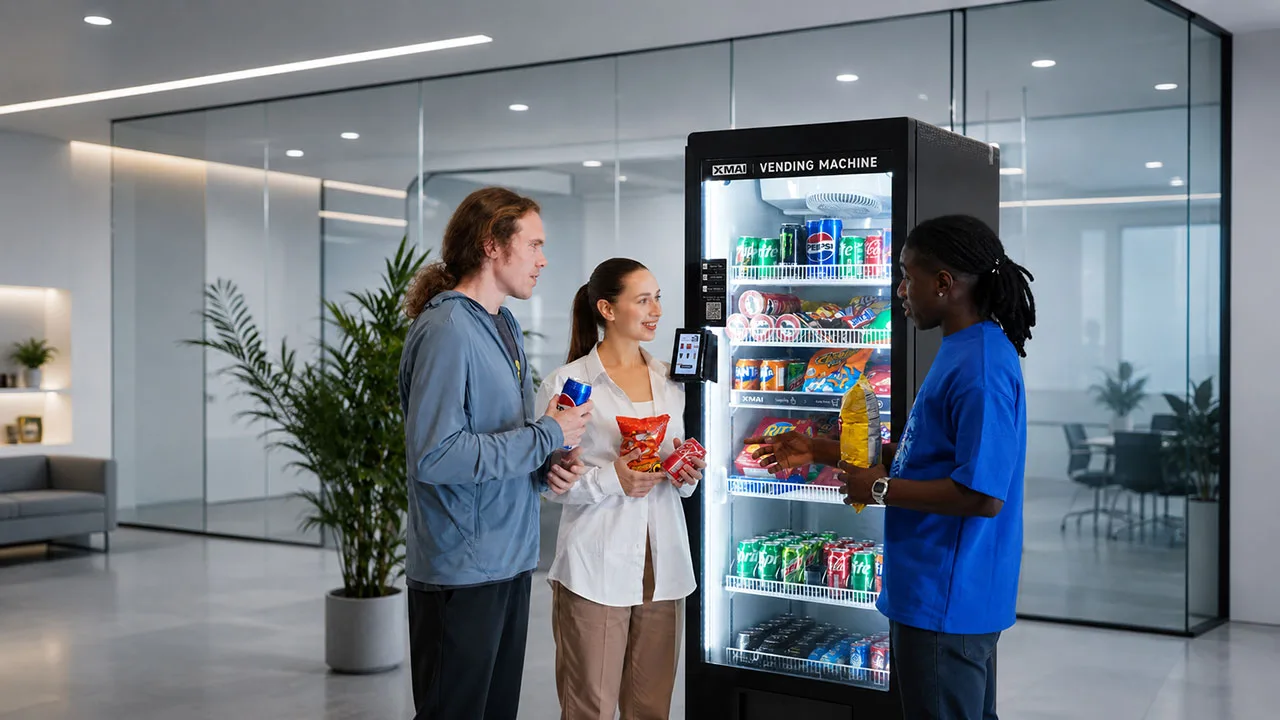
“AI vending machine” gets used for a lot of different things right now — some of it accurate, some of it marketing dressed up to sound more advanced than it is. If you’ve seen the term on five different sites and gotten five different explanations, that’s not you missing something. The category itself hasn’t settled on a shared definition yet.
Here’s what the term should mean, and what to check for when a manufacturer uses it.
What is an AI vending machine?
At its core, an AI vending machine is a cashless, unattended retail unit that uses computer vision — cameras plus machine learning — to identify what a customer takes out of the cabinet, rather than relying on coils, barcode scans, or weight sensors alone. No cash slot, no PIN pad for product selection. The customer authenticates with a card or phone, takes what they want, and the system figures out the rest.
Where the term gets stretched: some machines marketed as “AI-powered” are really just a traditional coil or shelf machine with a touchscreen bolted on for menu browsing. That’s not nothing, but it’s not the same category as a machine that’s actually tracking items with vision-based recognition. Worth asking directly what’s doing the recognition — camera, weight sensor, RFID, or some mix — before assuming “AI” means the same thing across two quotes.
How AI vision vending works
The mechanics are simpler than the term makes them sound. Cameras inside the cabinet record the state of the shelves the moment the door opens. When the door closes, the system compares that snapshot to the new state and identifies exactly what changed — what was taken, what was put back. The customer is only charged for what’s actually gone.
Most systems run on a hybrid setup: recognition happens locally on the device so the transaction settles the moment the door closes, without waiting on a network round-trip, while the underlying model keeps improving as it processes more transactions in the field. Accuracy claims are worth scrutinizing here too — a number generated in a lab under controlled lighting isn’t the same as a number generated from real transactions across hundreds of thousands of machines in real locations, with real lighting, real product variety, and real edge cases. XMAI’s recognition system, for reference, runs at 99.7% accuracy pulled from actual transaction data across more than 300,000 deployed units — not a lab benchmark.
Tap, grab, and go checkout experience
From the customer’s side, the whole interaction is closer to opening your own fridge than checking out at a register. Tap a card or phone to unlock, take what you want, close the door. No app download, no account creation, no scanning items one by one. If someone changes their mind mid-browse and puts something back, the system tracks that too — they’re not charged for it.
That simplicity is doing real work for operators, not just customers. Fewer steps in the transaction means faster turnover in high-traffic spots, and it removes the friction that causes people to walk away from a machine that feels like too much hassle for a bag of chips.
Cashless payment and automatic item recognition
Payment and recognition work together, not separately. The card gets pre-authorized before the door unlocks — confirming it’s valid before anyone touches a product — and the actual charge is calculated after the door closes, based on what the vision system recorded. Full support typically includes Visa, Mastercard, American Express, Discover, and mobile wallets like Apple Pay and Google Pay. Amex support specifically is worth checking for — it’s a common gap on cheaper card readers, and one that annoys a meaningful slice of customers when it’s missing.
Remote inventory and restock management
The same camera and sensor data that powers checkout also feeds an operator dashboard — real-time visibility into stock levels, sales by SKU, device status, and temperature, viewable without a site visit. Low-stock alerts flag a location before the shelf is actually empty, which changes restocking from a fixed weekly route into something based on what’s actually selling. For an operator running more than a couple of locations, that’s often the bigger operational shift — less time driving to check machines that turned out to be fine, more time at the ones that actually needed a visit.
Best locations for AI vending machines
AI vending machines tend to perform best in spots with steady, semi-captive foot traffic — offices, apartment buildings, gyms, campuses, hospitals, factories. The common thread across good locations isn’t really about the tech; it’s about traffic density and limited nearby alternatives. A location with 40+ regular daily users and few competing food or drink options nearby tends to outperform a lower-traffic spot regardless of which machine sits there. The AI layer improves margins and reduces operating overhead at a good location — it doesn’t manufacture demand at a bad one.
Request pricing
If you’re evaluating AI vending machines for a specific location, tell us the traffic and space and we’ll recommend a model with real numbers attached.
Email: sales@xmaivending.com
Phone: +1 (650) 307-1228