

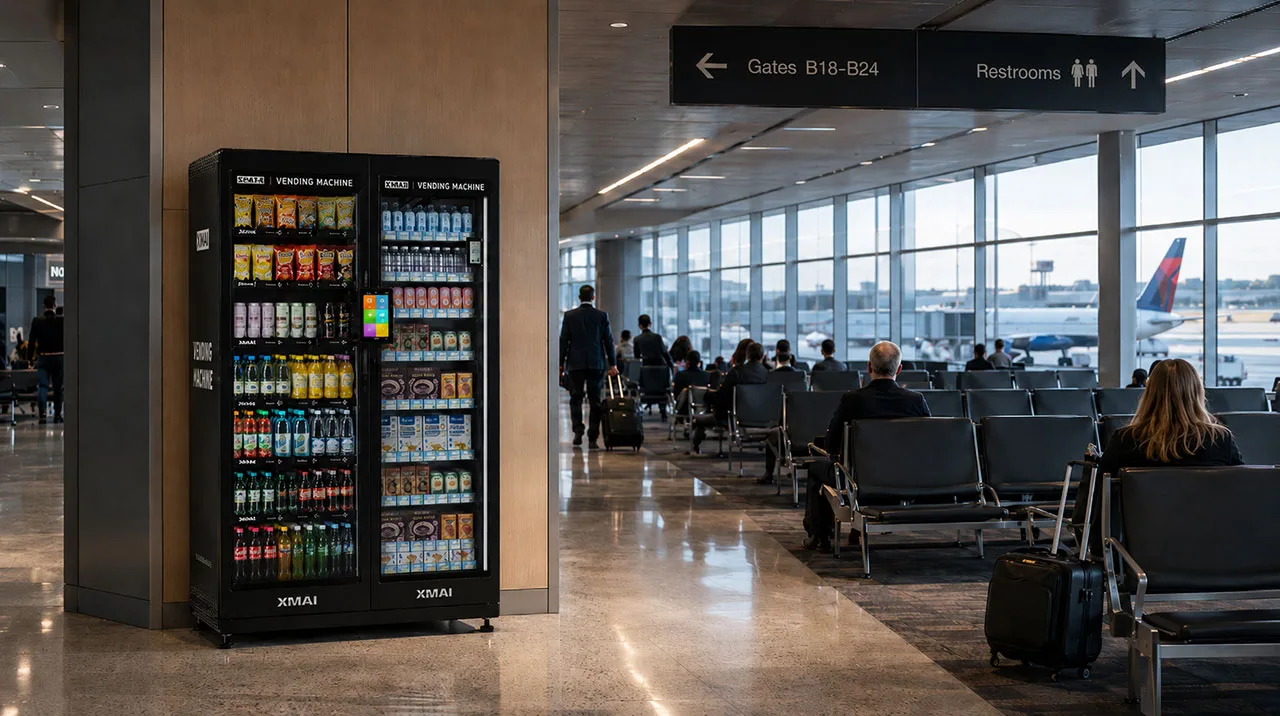
If you’ve searched “how to start a vending machine business,” you’re probably looking at one of the lowest-overhead ways to build a semi-passive income stream in the U.S. today. Unlike a storefront or franchise restaurant, a vending machine business doesn’t require rent for an entire building, a large staff, or years of industry experience — it requires a location, a machine, and a plan.
This guide walks through exactly what a vending machine business is, whether it’s still a good opportunity in 2026, and the specific steps to go from “just an idea” to running your first machine.
What Is a Vending Machine Business?
A vending machine business is simple in concept: you place one or more automated retail machines — snack, drink, or AI-powered smart coolers — in locations with reliable foot traffic, stock them with products, and collect revenue from every sale. As the vending machine owner, your core responsibilities are choosing good locations, keeping machines stocked, and monitoring sales performance.
There are a few common business models under this umbrella:
- Traditional snack and drink machines— coin/bill-operated, no real-time inventory tracking
- Snack vending machine business (spiral/coil machines)— the most familiar format, selling chips, candy, and bottled drinks
- Combo machines— snacks and drinks in one unit
- AI-powered smart coolers— cashless, camera-based machines that let customers open the door, grab what they want, and walk out, with AI automatically charging their card for exactly what they took
Vending machine ownership today increasingly means the second category — smart, connected machines that report sales and inventory in real time, rather than the mechanical spiral machines of the past.
Is a Vending Machine Business a Good Opportunity Right Now?
Vending machine business opportunities have grown significantly as the technology has improved. A few reasons this space is attracting new operators in 2026:
- Low barrier to entry— you don’t need a storefront, a large team, or years of retail experience to place your first machine
- Flexible time commitment— many operators run their vending routes alongside a full-time job before scaling up
- Recurring revenue per location— a well-placed machine generates sales every day it’s in operation, without you being physically present
- Technology has changed the economics— AI-powered smart coolers with dynamic vision recognition let one machine carry more product categories (drinks, snacks, fresh food, even personal care items) than a traditional spring-coil machine, which increases revenue per square foot of floor space
That said, it’s not “set it and forget it.” Vending business ideas that succeed are the ones built around a real plan for location selection, restocking logistics, and cash flow — which is exactly what the steps below cover.
How to Start a Vending Machine Business: Step-by-Step
Here’s the step-by-step process for how to start a vending machine business, whether your goal is one machine on the side or a multi-location route.
Step 1: Choose Your Vending Business Model and Niche
Before buying equipment, decide what you’re selling and to whom. A snack vending machine business targeting office breakrooms has different economics than a drink-focused machine in a gym, or a full AI smart cooler stocked with fresh food in an apartment lobby. Popular vending business ideas by location type include:
- Offices and coworking spaces— snacks, drinks, coffee
- Apartment complexes and dorms— grab-and-go meals, drinks, snacks
- Gyms and fitness centers— protein drinks, healthy snacks, supplements
- Schools, hospitals, and factories— high-volume, high-traffic locations with long operating hours
Matching your product mix to the location’s foot traffic is the single biggest factor in whether a location performs well.
Step 2: Build a Simple Business Plan and Budget
You don’t need a 40-page business plan, but you do need clarity on:
- How many machines you’re starting with
- Your total startup budget (equipment, delivery, initial inventory, any licensing fees)
- Your target monthly revenue per machine
- How you’ll finance the equipment (cash, financing, or a combination)
This is also the stage to decide whether you’ll register as an LLC or sole proprietor — most new operators start as an LLC for liability protection, which is inexpensive and quick to set up in most states.
Step 3: What Do You Need to Start a Vending Machine Business?
This is one of the most common questions new operators ask, and the requirements are more approachable than most people expect. At minimum, you’ll need:
- A business entity(LLC recommended) and an EIN from the IRS
- A vending machine or machines— new or used, purchased outright or financed
- A location agreement— a signed agreement with the property owner or manager where your machine will sit, often including a commission or flat rental fee
- Initial product inventory
- A way to accept cashless payment— most locations today expect card and mobile tap-to-pay, not just coins
- General liability insurance— protects you if a machine malfunctions or causes property damage
- Local permits or health permits, if applicable — required in some states for food and beverage vending, especially for perishable items
Some states and cities also require a vending machine license or a seller’s permit for sales tax collection — a quick call to your local city clerk’s office or Secretary of State will confirm what’s required where you plan to operate.
Step 4: Choose the Right Vending Machines
This is where your machine choice can make or break your margins. Traditional coin-operated machines are cheaper up front but limited: no real-time inventory data, higher theft and jam risk, and a shopping experience that feels dated to today’s customers.
AI-powered smart coolers, like XMAI’s lineup of five vision-recognition models, are built specifically to solve the pain points that make traditional vending harder to scale:
- Dynamic Vision AIautomatically recognizes what a customer picks up and charges only for items actually taken — no barcode scanning, no manual checkout
- Tap-to-open, walk-out payment— customers unlock the door with a card or phone, grab what they want, and the machine settles the transaction the moment the door closes, which increases basket size and purchase conversion compared to coin machines
- Remote management— check sales, inventory levels, and machine health from a phone or laptop instead of driving to every location to check stock
- Flexible entry point— XMAI’s “Start with $500. Pay as You Earn” financing structure, plus interest-free installment options over 3–6 months, lowers the cash needed to place your first machine
- Nationwide U.S. warehousing(New Jersey, Texas, and California) means new operators can typically get a machine delivered and running within 2–3 weeks of ordering
Whichever machine type you choose, the goal is the same: minimize the operational headaches (restocking trips, cash handling, theft, jams) that eat into your time and margin.
Step 5: How to Set Up a Vending Machine
Once you’ve secured a location and a machine, setup typically follows this sequence:
- Confirm the space meets power and clearance requirements— most machines need a standard 120V outlet and roughly 36 inches of clearance in front for the door to open fully
- Arrange delivery and placement— many suppliers offer white-glove delivery, or you can pick up from a regional warehouse
- Connect the machine to power and network(Wi-Fi, Ethernet, or cellular data, depending on the model)
- Load your initial product mixbased on what you expect to sell fastest in that location
- Set up payment processing— link your card reader and business bank account
- Test a transactionbefore leaving the machine live, to confirm everything from checkout to receipt is working correctly
For AI smart coolers, most manufacturers — including XMAI — provide remote setup support to walk you through account activation, payment linking, and your first live transaction, so you don’t need deep technical experience to get a machine online.
Step 6: Plan Your Financing and Startup Budget
Very few new vending machine owners pay 100% cash for their first machine. Financing options commonly available include:
- Manufacturer financing— a down payment (often 30–50%) with the remainder split into interest-free installments over a few months
- Small business loans or lines of credit
- Equipment leasing, if you’d rather avoid a large upfront purchase
Whatever you choose, make sure you’re also budgeting for the ongoing costs — not just the machine price. These include monthly software/SaaS fees, cellular data fees, payment processing rates, and occasional restocking travel costs. (We break these numbers down in detail in our companion guide, “How Much Do Vending Machines Cost.”)
Step 7: Launch, Monitor, and Scale
Once your first machine is live, your job shifts from “getting started” to “getting good.” Track sales by SKU, adjust your product mix based on what’s actually selling, and use any remote monitoring dashboard to catch low-stock or maintenance issues before they cost you a sale. Most successful vending machine owners don’t stop at one unit — once a location proves itself profitable, the same playbook (location, machine, product mix) gets repeated at the next site.
Common Mistakes First-Time Vending Machine Owners Make
- Choosing a location based on convenience rather than foot traffic— a nearby spot with low daily traffic will underperform a farther location with 100+ regular visitors
- Underestimating restocking frequency— high-traffic locations may need restocking two to three times a week, not once
- Ignoring cashless payment— a large share of vending customers today expect to tap a card or phone; cash-only machines lose sales
- Skipping the location agreement— a handshake deal without clear terms can lead to your machine being removed with no notice
- Buying the cheapest machine instead of the most reliable one— frequent breakdowns cost more in lost sales and service calls than the money saved upfront
Why More Operators Are Choosing AI Smart Coolers Over Traditional Machines
Traditional coin-and-coil vending machines built the industry, but they were built around a “sell one item at a time” experience. AI-powered smart coolers change the core value proposition: instead of just dispensing a product, the machine tracks everything a customer takes, supports a much wider product range (drinks, snacks, fresh food, and more), and gives the operator real-time visibility into every location from one dashboard.
XMAI has shipped over 300,000 AI vision-recognition vending machines to more than 5,000 operators across offices, apartments, factories, and campuses, with recognition accuracy validated at 99.7% in real-world operating conditions — not just lab testing. For new operators asking how to start a vending machine business with the least operational friction, that combination of low down payment, U.S.-based warehousing, and remote setup support is designed to make the first 30 days meaningfully easier.
FAQ: Starting a Vending Machine Business
How much does it cost to start a vending machine business?
Costs vary widely depending on machine type, but new operators can start with as little as a few hundred dollars down when financing is available. See our full breakdown in “How Much Do Vending Machines Cost.”
Do I need a license to start a vending machine business?
Requirements vary by state and city. Most operators need a business entity (LLC), an EIN, and in some cases a seller’s permit or health permit for food and beverage items. Check with your local city or county clerk’s office.
Can I run a vending machine business part-time?
Yes — many operators start with one or two machines while keeping a full-time job, then scale up once locations prove profitable.
What’s the difference between a traditional vending machine and an AI smart cooler?
Traditional machines dispense one item at a time and often accept cash. AI smart coolers use camera-based recognition to let customers open the door, take what they want, and automatically get charged the correct amount when the door closes — no barcode scanning required.
Is a vending machine business profitable?
Profitability depends heavily on location and product mix. We cover real revenue and profit benchmarks in our companion article, “Are Vending Machines Profitable?”